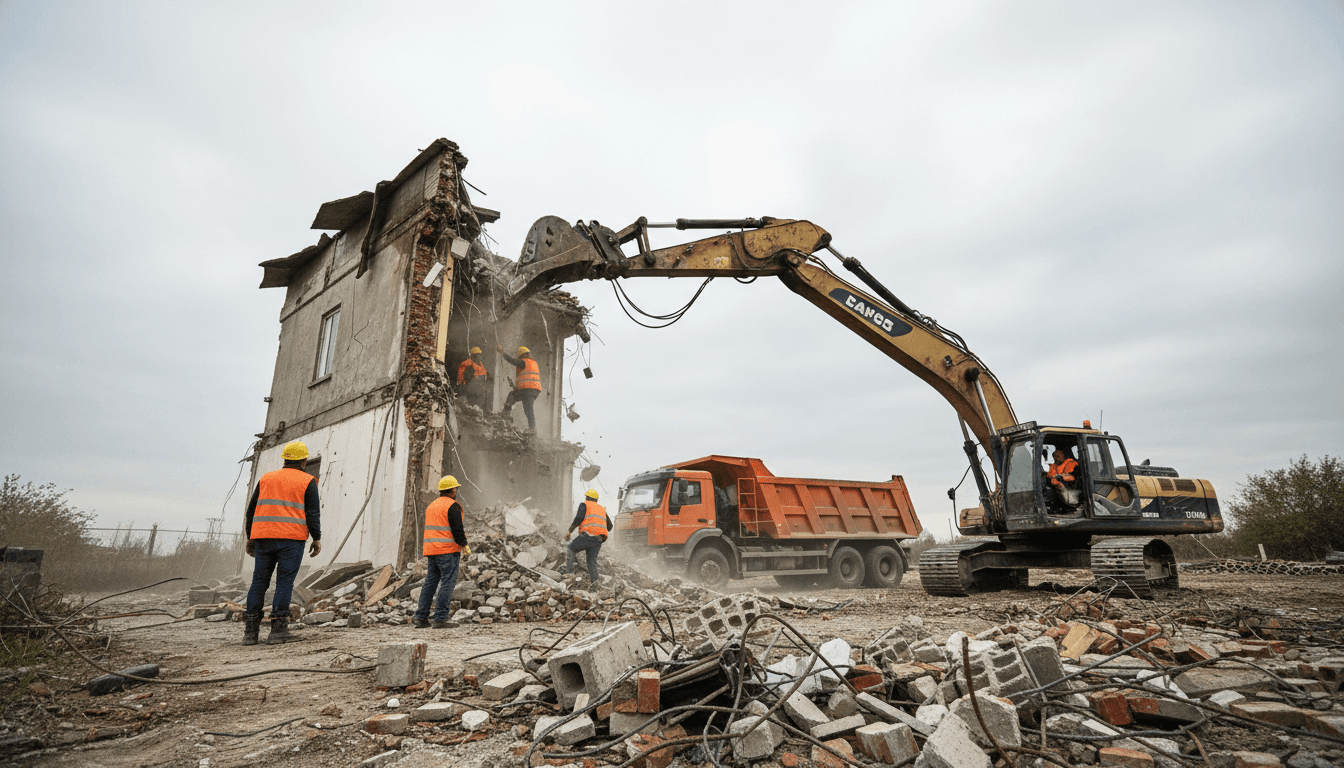

House demolition Orange County typically costs between $15,000 and $104,670, with final prices influenced by structural size, foundation type, and hazardous material removal. The process requires securing municipal permits, conducting required asbestos surveys, and hiring licensed professionals to ensure compliance with local building codes.
Taking down a residential structure in Orange County involves far more than simply clearing a lot for your new project. Homeowners often find themselves overwhelmed by the technical complexities of South Coast AQMD regulations, neighborhood noise ordinances, and the logistical challenges of coastal site access. A single permitting oversight can delay your construction timeline by months and inflate your budget significantly. At Orange County Site Work Services, we understand that a successful teardown is the foundation of your future build. In this guide, we will break down the local cost drivers and the specific permitting requirements unique to our region. You will learn the difference between mechanical demolition and sustainable deconstruction, the essential five step process for a professional teardown, and how to transition seamlessly from a cleared lot to your new foundation.
Understanding House Demolition Costs in Orange County
Estimating the financial scope of a house demolition in Orange County requires looking beyond national averages. While generic construction guides often quote $4 to $10 per square foot, these figures rarely account for the specific labor rates, landfill tipping fees, and regulatory requirements unique to Southern California. In our experience, residential projects in cities like Laguna Beach or Tustin typically range from $15,000 to $95,000 depending on the project's complexity.
For a realistic budget, homeowners should expect all-in costs to land between $23 and $25 per square foot. This comprehensive figure accounts for the structural teardown, concrete slab removal, and the significant expense of hauling debris to authorized facilities.
House Size | Estimated "All-In" Cost Range |
|---|---|
1,500 Square Feet | $34,500 to $37,500 |
2,000 Square Feet | $46,000 to $50,000 |
3,500+ Square Feet | $80,000 to $95,000+ |
The method of removal also dictates the final invoice. Most property owners opt for mechanical demolition, which utilizes heavy equipment like Bobcats and excavators to quickly clear the site. This is generally the most cost-effective path. Conversely, deconstruction focuses on hand-stripping the structure to salvage materials like timber, fixtures, and appliances. While eco-friendly, deconstruction typically costs 25 to 50 percent more than mechanical methods because it is extremely labor intensive.
Securing comprehensive demolition and hauling solutions ensures that your budget accounts for every variable, from the initial survey to the final site clearing. When comparing bids for a house demolition in Orange County, it is vital to confirm if the price includes the removal of footings and foundation slabs. These items add substantial weight to disposal loads and can lead to unexpected surcharges if they are not transparently quoted in the initial project scope.
Local Factors that Influence Your Demolition Budget

One of the most significant budget drivers for house demolition Orange County projects is the local waste management policy. In cities like Newport Beach and Irvine, exclusive franchise hauler agreements dictate who can transport construction and demolition debris. Because property owners cannot shop around for the lowest hauling rates, these mandated services often inflate the debris removal portion of a budget by 20 to 30 percent compared to cities with open competition.
Logistical constraints also dictate equipment choice and labor hours. In Laguna Beach, narrow canyon roads and steep hillside lots frequently prevent the use of high volume 40 yard dumpsters or large excavators. We often utilize smaller Bobcats and specialized comprehensive demolition and hauling solutions to navigate tight coastal properties. While smaller equipment is agile, it requires more individual trips to clear a site, which naturally increases the time and labor required for structural removal.
Factor | Budget Impact | Practical Constraint |
|---|---|---|
Franchise Hauling | High | Limited to city-contracted waste providers. |
Hillside Access | Medium to High | Requires smaller equipment and more labor hours. |
Concrete Slabs | High | Increases total weight and landfill tipping fees. |
Coastal Setbacks | Variable | Requires precision work to protect neighboring structures. |
The physical composition of the home itself, particularly the foundation, impacts the final tonnage. Many Southern California homes are built on thick concrete slabs rather than crawl spaces. A standard 2,000 square foot home can yield over 35 tons of concrete once the slab and footings are pulled. Since landfill tipping fees are calculated by weight, these heavy foundations are a primary reason why local projects carry higher price tags than national averages. Proper planning during the grading and site preparation phase ensures these materials are handled efficiently without surprising the property owner with hidden disposal surcharges.
The Orange County Permitting Process and AQMD Requirements
Navigating the legal landscape is often the most time consuming phase of a teardown. Before any equipment arrives on site, a house demolition Orange County project must comply with strict regional and local mandates that prioritize public safety and environmental health.
The South Coast Air Quality Management District (SCAQMD) enforces Rule 1403, which requires a certified asbestos survey for every structure, regardless of the year it was built. Property owners often assume newer homes are exempt, but hazardous materials can still exist in adhesives, drywall joint compounds, or roofing materials. Once the survey is complete, you must file a formal notification with the SCAQMD at least 10 working days before any structural disturbance begins. This waiting period is non-negotiable; starting early can result in significant fines and project shutdowns.
In cities like Laguna Beach, additional layers of oversight apply. The building department requires that all work be performed by a city licensed contractor who carries specific bonds and insurance. Furthermore, the city will not issue a demolition permit until you provide formal letters of verification from utility providers. The sequence of utility disconnects typically follows a specific order:
Electricity: Southern California Edison must retire the service and remove the meter.
Gas: Southern California Gas Company must disconnect the line at the street or cap it at the meter.
Water and Sewer: The local district must verify the service is capped to prevent site flooding or contamination.
Professional comprehensive demolition and hauling solutions include managing these timelines to prevent project stalls. Referencing an Orange County grading permit guide can also help you understand how these initial steps impact the subsequent grading and site preparation phases.
Mechanical Demolition vs Deconstruction: Which is Right for You?
Choosing between mechanical demolition and deconstruction involves balancing your timeline against your environmental goals. Mechanical demolition is the most common approach for a house demolition Orange County project. It utilizes heavy machinery like Bobcats and excavators to systematically tear down the structure, typically completing the physical removal in just a few days. This method is efficient and provides the most predictable budget for homeowners.
In contrast, deconstruction involves hand-stripping the home to salvage materials like old-growth timber, vintage fixtures, or high-end appliances. While this eco-friendly approach can divert up to 80 percent of materials from landfills and may offer tax benefits through charitable donations, it is significantly more labor intensive. In Southern California, the high cost of skilled labor often makes deconstruction 25 to 50 percent more expensive than mechanical methods.
Feature | Mechanical Demolition | Deconstruction |
|---|---|---|
Primary Equipment | Bobcats, Excavators | Hand tools, small power tools |
Project Duration | 2 to 5 days | 2 to 4 weeks |
Cost Level | Baseline | 25-50% Higher |
Sustainability | Recycles concrete and metal | High material salvage rate |
When clients ask if it is better to demolish or deconstruct, we look at the project goals. For a standard residential rebuild, mechanical demolition is usually the practical choice. It allows for a faster transition to grading and site preparation while keeping costs manageable. Deconstruction is generally reserved for historical structures where material preservation is mandated or for property owners with a specific mandate for maximum waste diversion. Our comprehensive demolition and hauling solutions focus on mechanical efficiency to ensure your site is cleared and ready for the next phase without unnecessary delays.
The 5 Step Process of a Professional Residential Teardown

Executing a house demolition Orange County project requires a disciplined sequence to maintain safety and regulatory compliance. The physical teardown follows a specific five step workflow to ensure the site is ready for the subsequent grading and site preparation.
Survey and Abatement: Before any heavy machinery arrives, certified specialists must identify and remove hazardous materials like asbestos or lead based paint. This step ensures that airborne contaminants are not released during the main demolition phase, protecting both our crew and the surrounding neighborhood.
Utility Disconnects and Capping: We verify that Southern California Edison and SoCalGas have retired their respective services. Capping sewer and water lines at the property line prevents site flooding during excavation. Following the steps in an Orange County grading permit guide ensures these disconnects are properly documented before the city signs off on the teardown.
Structural Demolition: Using a top down approach, our team utilizes Bobcats or excavators to collapse the structure inward. This technique prevents debris from spilling onto neighboring properties or coastal setbacks. Constant dust control is mandatory; we use high pressure hoses or water trucks to stay compliant with SCAQMD air quality regulations.
Slab and Footing Removal: Once the vertical structure is gone, we focus on the foundation. In Southern California, this often involves breaking up thick concrete slabs and pulling deep footings that are not always visible from the surface. Removing every piece of concrete is essential for future structural integrity.
Hauling and Site Clearing: The final step involves our comprehensive demolition and hauling solutions to transport debris to authorized recycling centers or landfills. We leave the site flat and free of "hidden" debris like buried wood or metal.
Step | Primary Focus | Regulatory Requirement |
|---|---|---|
1. Abatement | Hazardous material removal | SCAQMD Rule 1403 |
2. Disconnects | Capping water, gas, and electric | City Utility Verification |
3. Structural | Top-down mechanical removal | Dust Suppression (Water) |
4. Foundations | Slab and footing extraction | Concrete Recycling Codes |
5. Hauling | Load transport and site clearing | Franchise Hauler Compliance |
Preparing for the Rebuild: What Happens After the House is Gone?

The completion of a house demolition Orange County project marks a transition point rather than a finish line. A common mistake in residential development is treating the teardown and the rebuild as entirely separate silos. In reality, the quality of the demolition directly dictates the success of the new foundation. If a contractor leaves behind buried organic material, sections of old footings, or loose fill dirt, the site will fail subsequent soil compaction tests; this leads to costly delays or structural settling years down the line.
Once the debris is cleared, we transition immediately into grading and site preparation. This phase includes several technical steps that bridge the gap between a cleared lot and a construction site:
Phase | Action Item | Purpose |
|---|---|---|
Rough Grading | Leveling and contouring the lot | Ensures proper drainage away from the new structure. |
Compaction Testing | Mechanical soil stabilization | Verifies the ground can support the weight of a new home. |
Utility Trenching | Excavating paths for new lines | Positions water, sewer, and electric for the new footprint. |
Export/Import | Balancing the site soil | Removes unsuitable dirt or brings in structural fill. |
A clean demolition involves pulling every deep-seated pier and clearing all underground obstructions. By utilizing a single team for both comprehensive demolition and hauling solutions and the follow up earthwork, you eliminate the communication gaps that often occur between separate contractors. The team that clears the lot is the same team responsible for the rough grade, ensuring the site meets the specific requirements outlined in your Orange County grading permit guide. This integrated approach keeps the project on schedule and ensures a stable, build-ready pad for your new home.
Completing a demolition project in Orange County requires careful planning, strict permit compliance, and a focus on safety. While understanding the process is the first step, managing the technical details and heavy machinery can be quite complex. If you want expert help to ensure your site is cleared safely and efficiently, you can explore our full range of Services to see how we support local rebuilding projects. We are here to help make your transition to a new build as smooth as possible.