Catch basin installation Orange County addresses local drainage challenges by effectively managing surface water runoff common in clay heavy soil environments. These systems utilize a grated basin to capture debris and water, channeling it through underground pipes to prevent localized flooding and protect residential foundations.
Orange County property owners often face a recurring frustration after a heavy Southern California rain. The region’s dense clay soil tends to trap water, leading to stagnant pools that threaten foundations and ruin expensive landscaping. In our experience at Orange County Site Work Services, these drainage failures are rarely solved with simple surface fixes. True moisture control requires a sophisticated, integrated approach tailored to expansive local soils. This guide provides a technical deep dive into professional catch basin installation, specifically focusing on how point source drainage integrates with trench and French drain systems. You will learn about the critical requirements for pipe depth, the necessity of precise site grading, and why DIY attempts often fail to manage the unique hydraulic pressure of clay. We also break down the long term ROI of protecting your property through engineered site work.
Why Orange County Clay Soil Demands a Professional Drainage Strategy
Property owners in South Orange County, particularly in Mission Viejo and Rancho Santa Margarita, deal with a specific geological challenge: expansive clay soil. Unlike sandy coastal soils, this heavy clay can expand by as much as 10 percent when saturated. This volume change creates significant hydrostatic pressure against concrete slabs and retaining walls, often leading to foundation shifts or structural cracking over time. Because clay is remarkably non-porous, water does not naturally percolate into the ground; instead, it pools on the surface, creating stagnant areas that damage landscapes and compromise the integrity of the soil.
Standard, generic drainage advice found in hardware stores often fails to account for the sheer density and resistance of Southern California terrain. A single catch basin installation Orange County project rarely solves the issue in isolation. True site stability requires an integrated strategy that addresses the unique way our local soil behaves.
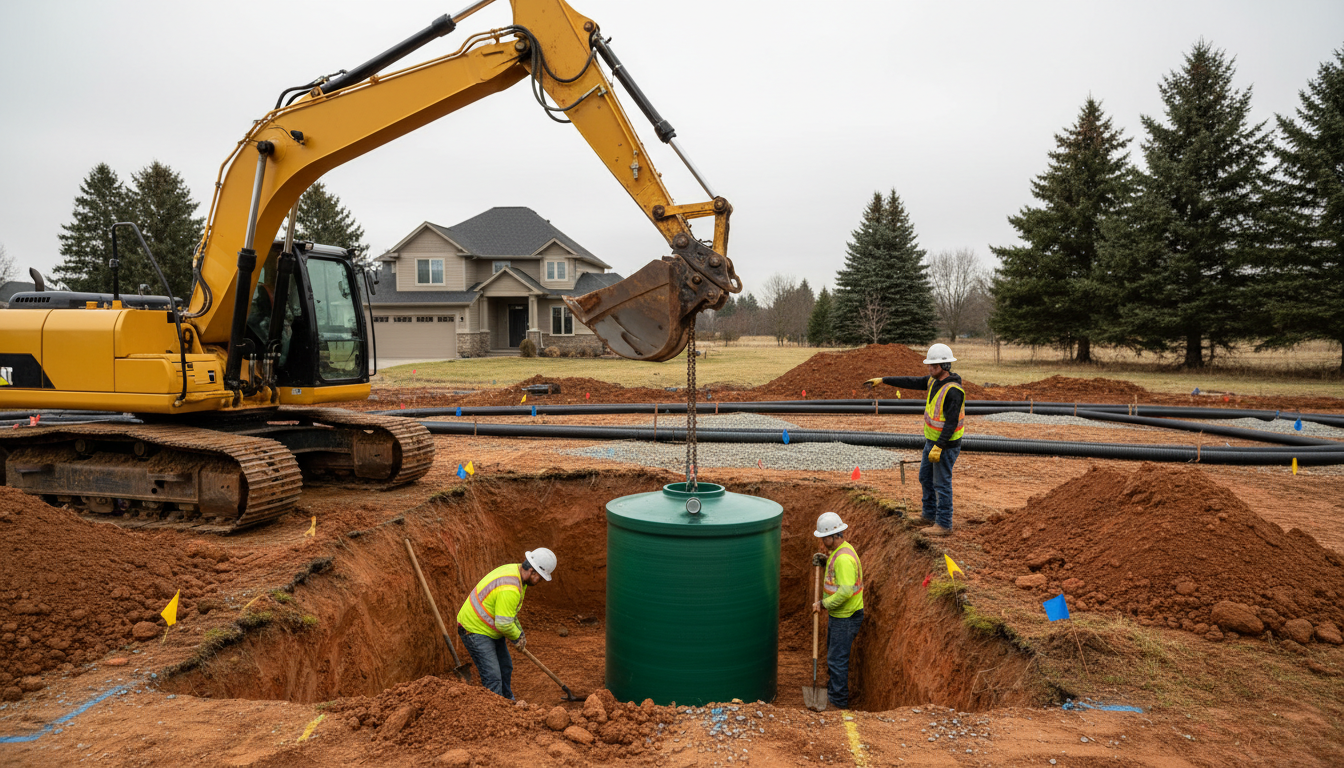
Effective water management requires a combination of foundation excavation services and precise site contouring. By using professional equipment to reshape the land, we ensure that water is actively directed toward collection points through a system of grading and trenching. Without this integrated approach, a drain is just a hole in the ground that the water will likely bypass entirely.
Catch Basin Installation Orange County: The Point Source Solution
A catch basin acts as a targeted drainage hub, intercepting surface runoff before it can saturate the surrounding soil. While linear drains handle wide areas, catch basins address specific point problems, such as a localized depression in a backyard or the terminus of a driveway where water naturally gravitates. By capturing water at these collection points, we prevent the standing pools that lead to the soil expansion issues common in our local clay.
The installation process begins with precise excavation. Using professional equipment like a Bobcat allows us to dig a footprint that is properly sized for the basin and its necessary bedding. This is critical in Orange County, where dense clay requires a stable, often oversized hole to allow for proper backfilling and compaction. Without mechanical excavation, it is difficult to reach the depths required to clear other lines, which can be found in our guide to utility trenching depths.
Material | Application | Durability |
|---|---|---|
High Density Polyethylene (HDPE) | Standard residential yards and planters | High corrosion resistance; standard for home use |
Pre-cast Concrete | Commercial driveways and high-traffic areas | Superior load-bearing; permanent structural solution |
Determining how many basins are required depends on the total square footage of your impervious surfaces and the existing topography. A large concrete patio or a long driveway generates significant volume during a heavy rain. One basin might handle a 500-square-foot area on a flat lot, but steeper hillsides or complex layouts often require multiple points of collection to prevent water from bypassing the system. Integrating these basins into a broader grading and drainage in Orange County plan ensures the system captures all runoff before it reaches the foundation.
Trench Drains vs French Drains in Expansive Soils
Moving beyond point source collection, linear drainage systems address water as it moves across wider stretches of a property. While often confused, trench drains and French drains serve two distinct roles in a grading and drainage in Orange County plan. Trench drains, also known as channel drains, are designed to intercept surface water sheet flow before it reaches a garage slab or foundation. These are typically installed in hardscapes like driveways or patios. Conversely, French drains are sub-surface systems designed to manage groundwater and alleviate hydrostatic pressure before it can saturate the soil near a structure.
In the expansive clay soils of South Orange County, the installation requirements for French drains are more stringent than in other regions. Because clay particles are exceptionally fine, they easily migrate into the drainage gravel, clogging the system within just two or three seasons if improperly built. We mitigate this by wrapping the entire gravel envelope in a high-quality non-woven filter fabric and using specific 3/4 inch clean crushed rock. This ensures the water can pass through while keeping the clay out.
Feature | French Drain | Trench (Channel) Drain |
|---|---|---|
Primary Goal | Sub-surface water mitigation | Surface water runoff management |
Surface Finish | Gravel or grass | Removable metal or plastic grate |
Ideal Location | Foundation perimeters; hillsides | Driveways; pool decks; garage thresholds |
Maintenance | Difficult if silted in | Easy access through surface grates |
Market data indicates that French drains hold about a 28 percent share of local drainage installations due to their popularity in landscape design. However, for properties located at the base of hillsides in areas like Irvine or Laguna Beach, trench drains are often the more essential component. They provide an immediate exit for heavy runoff that would otherwise overwhelm the soil. Integrating these linear solutions with professional foundation excavation services ensures that both surface and sub-surface water are accounted for, preventing the soil volume changes that threaten structural integrity. Proper installation requires reaching specific utility trenching depths to ensure the system has a clear path to the discharge point without interfering with existing home infrastructure.
Technical Requirements: Minimum Slope and Pipe Depth for OC Drainage
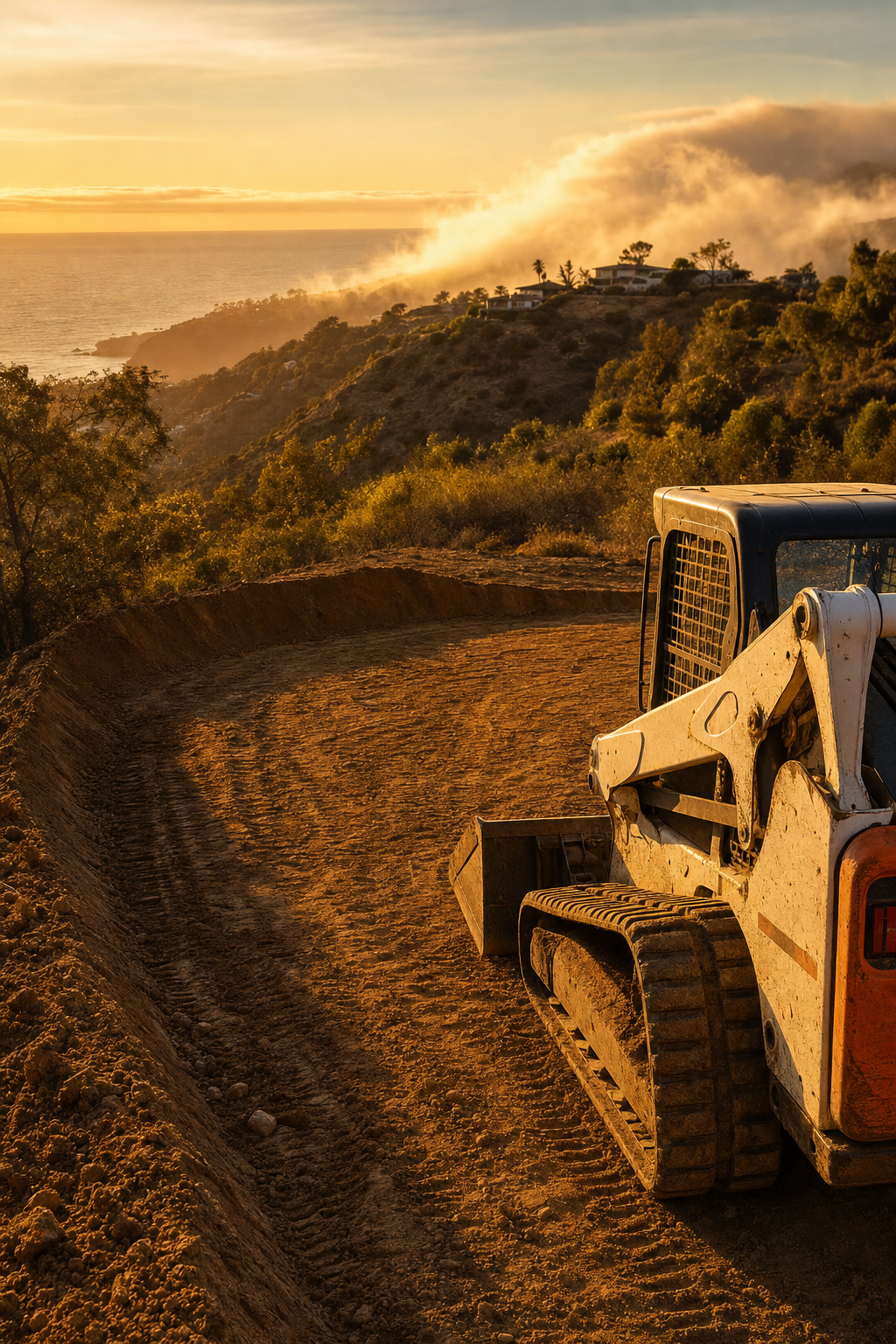
A successful catch basin installation Orange County relies on the physics of gravity. To ensure water moves quickly enough to prevent silt buildup in clay-heavy areas, we target a minimum slope of 1/4 inch per foot, which is a 2 percent grade. While a 1 percent slope can occasionally function for solid, smooth-wall PVC pipes over short distances, the 2 percent standard provides the necessary velocity to keep the system self-cleaning.
Depth is equally critical for long-term durability. In Southern California, drainage pipes should typically be buried between 12 to 24 inches deep. This depth protects the lines from being punctured by landscaping tools, crushed by vehicle traffic on driveways, or shifted by the surface expansion of clay common in our region.
Requirement | Specification | Rationale |
|---|---|---|
Minimum Slope | 1/4" per foot (2%) | Prevents sediment settlement in clay soil |
Standard Pipe Depth | 12 to 24 inches | Protects against traffic and landscaping |
Material Preference | Schedule 40 or SDR 35 PVC | Resists crushing and maintains internal flow |
Achieving these precise specs requires professional trenching. We use dedicated equipment to maintain a consistent fall across the entire run. If the trench floor is uneven, the system will develop "bellies" where water stands, eventually leading to pipe failure or mosquito issues. Proper utility trenching depths ensure your drainage interacts safely with existing gas and water lines while maintaining the necessary gravity-fed flow. Expert grading and drainage in Orange County ensures that the hardware is supported by a stable, correctly sloped foundation.
How Surface Grading and Drainage Systems Work Together
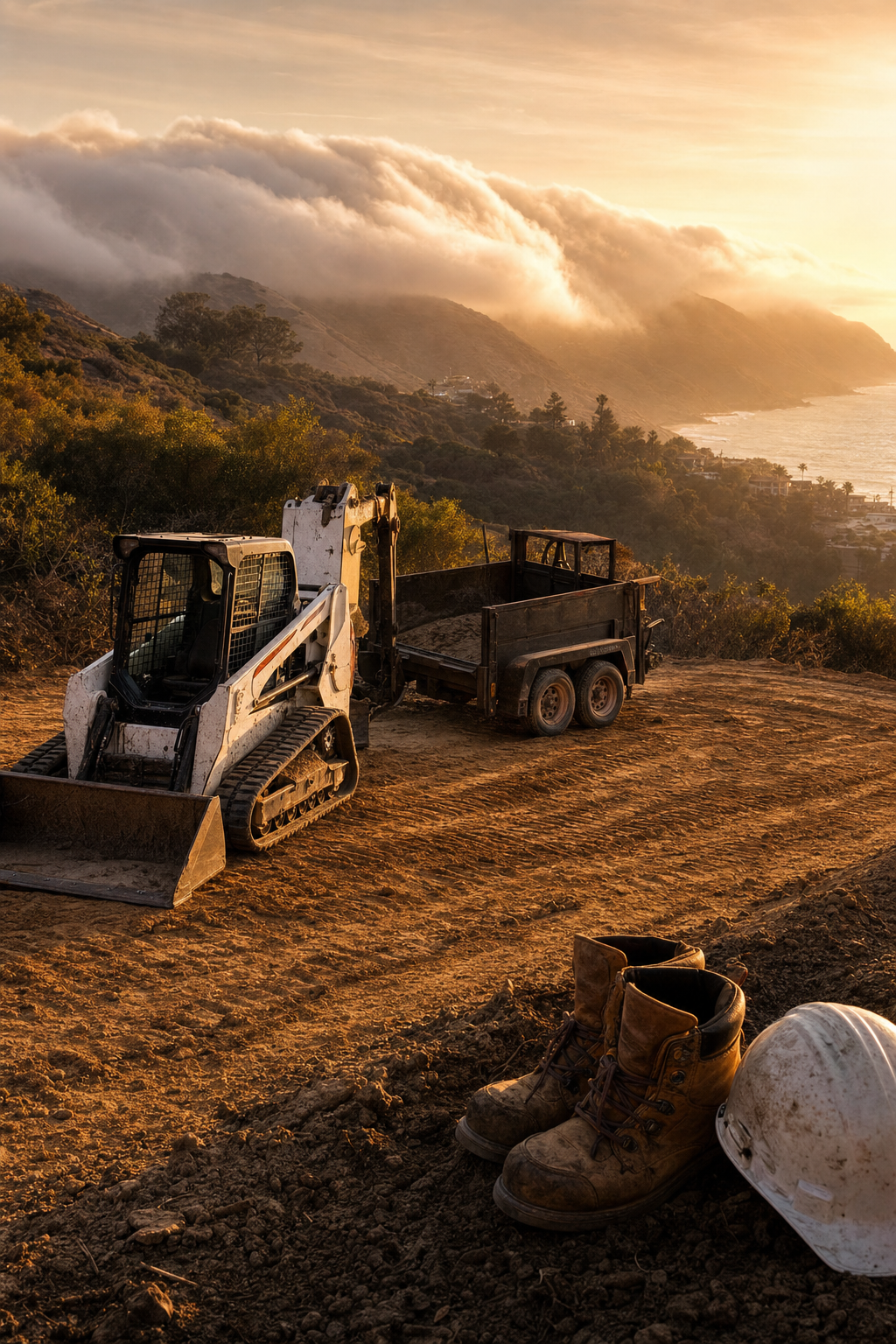
A catch basin is a stationary point, but water is dynamic. For a catch basin installation Orange County project to succeed, the surrounding topography must be engineered to force water toward the inlet. Professional site work involves more than just digging a hole for a box; it requires precise grading and drainage in Orange County to ensure no water bypasses the system.
We utilize cut and fill techniques to redistribute onsite soil, creating subtle valleys known as swales. These swales act as natural pathways, guiding runoff across the property toward the designated collection points. In the dense clay found throughout Mission Viejo and Laguna Beach, water will sit in pockets rather than flowing if the surface is not perfectly contoured. By integrating foundation excavation services with surface grading, we eliminate these low spots that would otherwise lead to soil saturation and foundation stress.
Grading Technique | Function | Benefit for OC Properties |
|---|---|---|
Swale Creation | Linear depressions to channel water | Directs runoff to basins without pipes |
Cut and Fill | Balancing soil volume on site | Stabilizes slopes and levels building pads |
Surface Contouring | Fine-tuning the top 6 to 12 inches | Ensures 2 percent minimum slope toward inlets |
Effective drainage is a partnership between hardware and earthwork. We focus on the initial heavy equipment work to shape the land, ensuring that the hardware is positioned at the absolute lowest point of a controlled slope. Without professional grading, even the most expensive catch basin will sit dry while water pools just a few feet away, eventually undermining the slab.
Common Mistakes in DIY Catch Basin Installation
DIY attempts at catch basin installation Orange County often fail due to material choices that do not withstand local soil pressures. One frequent error is using corrugated black tubing. While flexible, its interior ridges trap silt, making it nearly impossible to clear once saturated with fine clay particles. Professional systems utilize smooth-wall PVC to maintain velocity and simplify maintenance.
Another common oversight involves the catch basin sump. The outlet pipe should never be flush with the floor of the basin. Leaving a few inches of space below the pipe allows heavy sediment to settle at the bottom rather than entering and clogging the main lines. In the canyons of Laguna Beach and Irvine, failing to maintain a precise 2 percent slope leads to standing water within the pipes. This stagnant environment quickly becomes a breeding ground for mosquitoes, creating a public health nuisance in residential yards.
DIY Mistake | Professional Solution | Consequence of Error |
|---|---|---|
Corrugated Pipe | Smooth-wall PVC (SDR 35) | Permanent clogs from clay silt |
No Sump Depth | 2-4 inch debris reservoir | Clogged discharge lines |
Hand Tamping | Mechanical compaction | Basin settling and pipe shear |
Finally, poor compaction of backfill soil leads to significant settling. When clay is disturbed during foundation excavation services, it must be mechanically compacted to prevent the basin from sinking and pulling the system out of alignment. Maintaining proper utility trenching depths ensures the system remains stable and functional through seasons of soil expansion. Without the heavy equipment necessary for deep compaction, the grading and drainage in Orange County strategy will eventually fail as the soil reverts to its natural, uncompacted state.
Catch Basin Installation Cost and Project ROI in Southern California
Investing in a comprehensive catch basin installation Orange County project typically ranges from $3,700 to $7,400 for a fully integrated residential system. This price reflects the specialized equipment and labor required to handle local clay conditions. Several variables influence the final bid, including the need for precision concrete cutting in driveways, navigating existing infrastructure at specific utility trenching depths, and the high cost of soil disposal. Because South Orange County clay holds water so effectively, the spoils excavated during foundation excavation services must often be hauled off-site and replaced with permeable fill, adding to the logistics.
View this expense as foundation insurance. The cost of a proactive system is a fraction of the price of structural remediation. In areas like Mission Viejo, repairing a slab that has settled due to uncontrolled water intrusion can easily exceed $25,000, not including landscape restoration.
Project Component | Estimated Impact | Cost Driver |
|---|---|---|
System Installation | $3,700 - $7,400 | Materials, labor, and Bobcat operation |
Hardscape Modification | +$800 - $2,500 | Diamond-blade concrete cutting and patching |
Soil Export/Import | +$500 - $1,500 | Hauling heavy clay and bringing in clean rock |
Structural Repair | $20,000+ | Potential cost if drainage is neglected |
A professional approach to grading and drainage in Orange County ensures that your investment addresses the root cause of water accumulation, providing a permanent solution that protects the home's market value.
Managing drainage in Orange County requires a strategic approach due to the heavy clay soil found throughout the region. By installing an integrated catch basin system, you can effectively protect your property from standing water and erosion. While understanding these systems is the first step, achieving the right slope and placement can be complex. If you want expert help with your next drainage project, you can learn more about our team and our local site work. We are here to help your yard stay dry and functional.